
Richard Hebda
We are familiar with beans in Japanese cuisine such as the soy bean (Glycine max) as edamame and used for tofu and adzuki beans (mung bean=Vigna angularis). As you can tell by the botanical name neither of these are true beans which are technically in the genus Phaseolus. Both adzuki and soy beans have been grown in east Asia and Japan for thousands of years. Delicious common beans (Phaseolus vulgaris) are also grown in Japan both for fresh pods and dry seed. My sister brought me several packets in 2023, and I can report success growing one variety, known as Tora-mame or Tiger bean. Tora-mame is beautiful, productive and used for a special sweet dish in Japan.
Tora-mame beans apparently arrived in Japan from the United States in the late 1800s. And its ancestral US variety was known as Concord Pole bean. U.L. Hedrick in his Beans of New York, Vegetables of New York Volume 1 Part 2 (Education Dept. State of New York) of 1931 reported that Concord Pole arose in the mid 1800’s in Concord, Massachusetts as a natural inter-variety hybrid. Today new varieties of the original introduction are widely grown on the island of Hokkaido (see Japanese flower data base: https://www.flower-db.com/en/flowers/phaseolus-vulgaris-tora-mame).
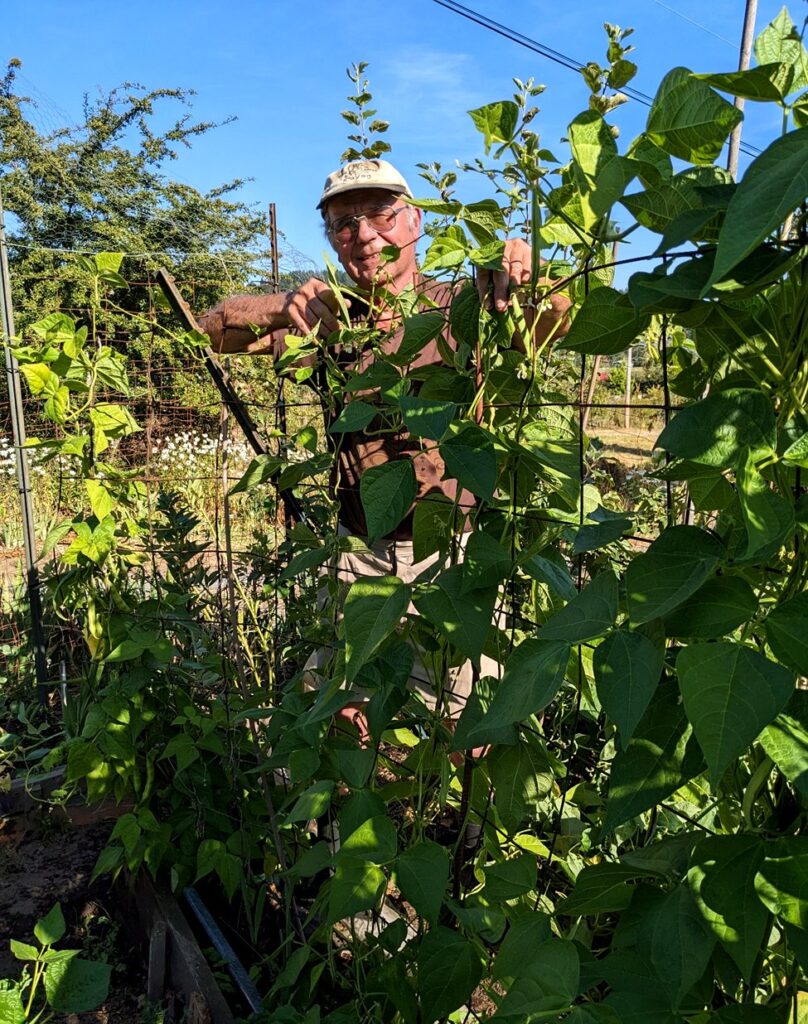
Robust climbing plants of Tora-mame common bean (Phaseolus vulgaris) with numerous buds and first flowers, Saanich Peninsula, July 28, 2025. Photo Christopher Hebda.
Tora-mame plants grow into tall open vines reaching 1.5-2 m (59-79”) tall. When widely spaced, the plants develop several branches and are best grown on a fence. Unlike many pole beans, growth is determinate, meaning it stops toward the end of the season as the pods mature. Greenish white flowers, faintly tinged pink, and then pods are produced evenly from the base to top of the plants.
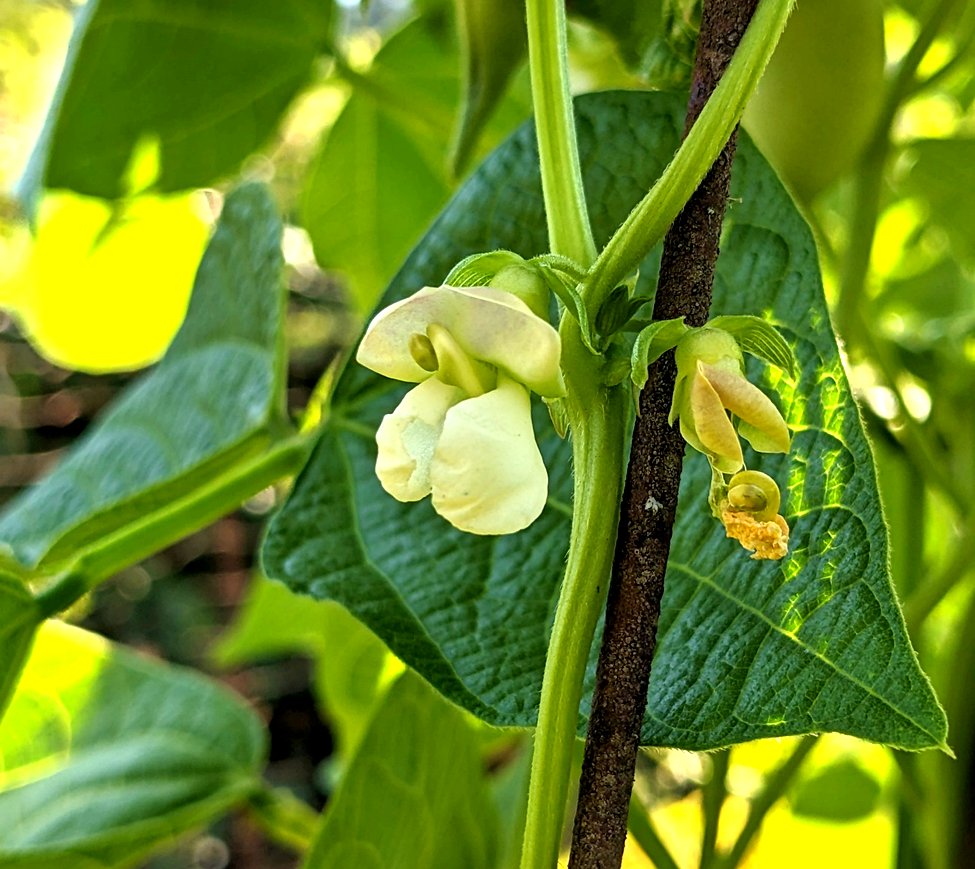
Paired greenish-white flowers of Japanese Tora-mame common bean (Phaseolus vulgaris) July 29, 2025, Saanich Peninsula. Photo Christopher Hebda.
Pods vary from straight to having a gentle even curve and turn faintly yellow when dry. Pods are short for a common, bean 9-13 cm (about 4-5 “) long (average 10.5 cm). At about 1.7 cm (2/3”), they are relatively wide for their length and somewhat flattened at 1.1-1.2 cm (1/2”) thick. The suture is strongly defined helping the pods to split easily and sometimes even explosively. The firm point varies from straight to curved, typically about 1.6 cm (5/8”) long.
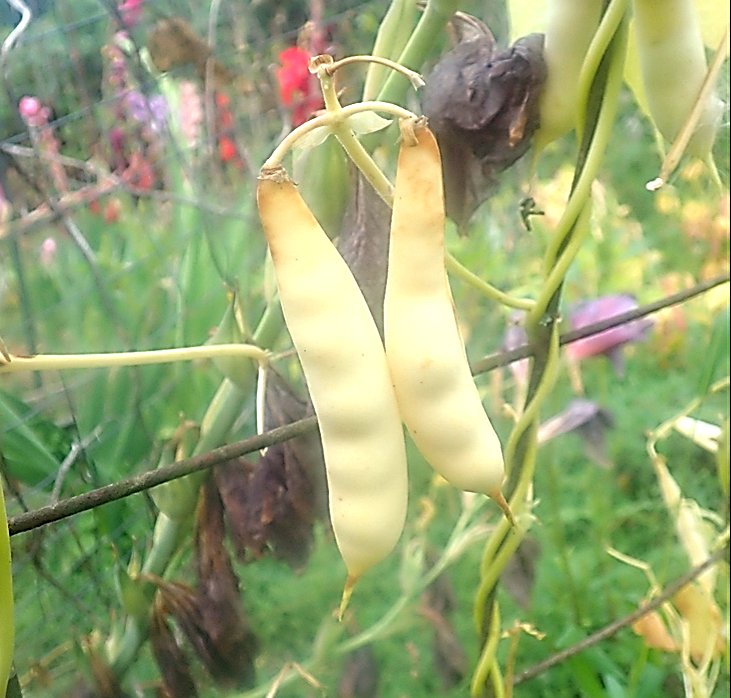
Pair of ripening pods on a Tora-mame common bean (Phaseolus vulgaris) plant. Most of the leaves have been shed indicating the determinate growth of this variety. Saanich Peninsula, August 12, 2024. Photo Richard Hebda.
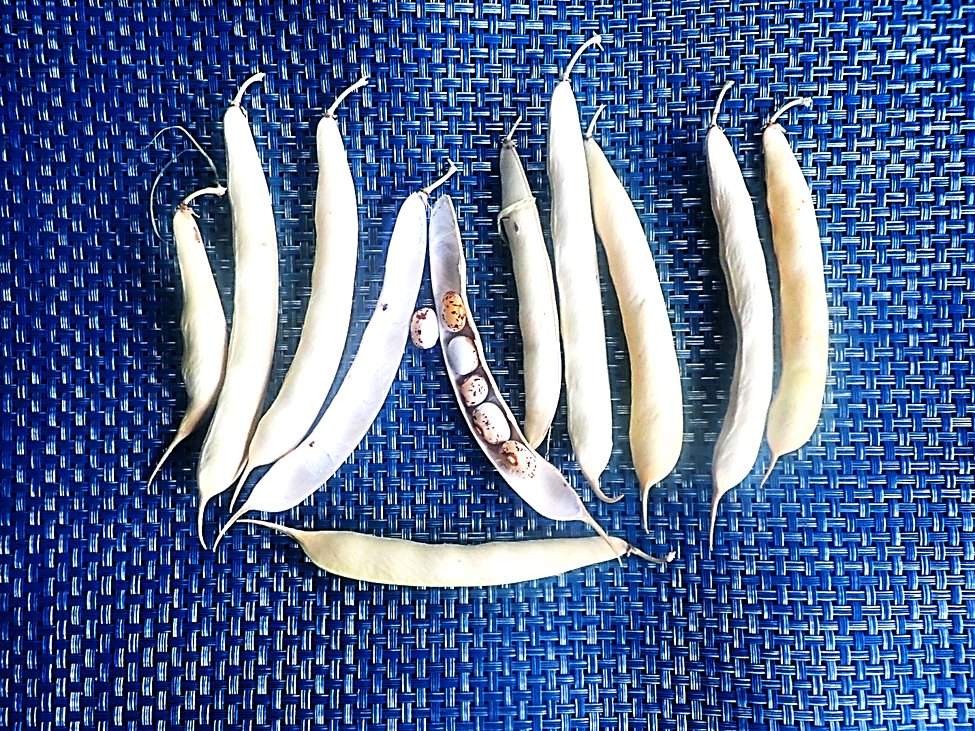
Dried pods of Tora-mame common bean (Phaseolus vulgaris) with one on the right showing strongly defined suture. Photo Richard Hebda.
There are 3-6 seeds per pod, usually 6. The seed outline is generally oval, however in a full pod one end of the seed becomes flattened and angled in contact with the next seed. Seeds are of moderate size ranging from 1.1 -1.4 cm (about ½”) long, about 1.1 cm (2/5”) wide and slightly less (0.7-0.9 cm) thick. The elongated white scar occurs along one side and may protrude slightly. A gentle brown zone surrounds the scar.
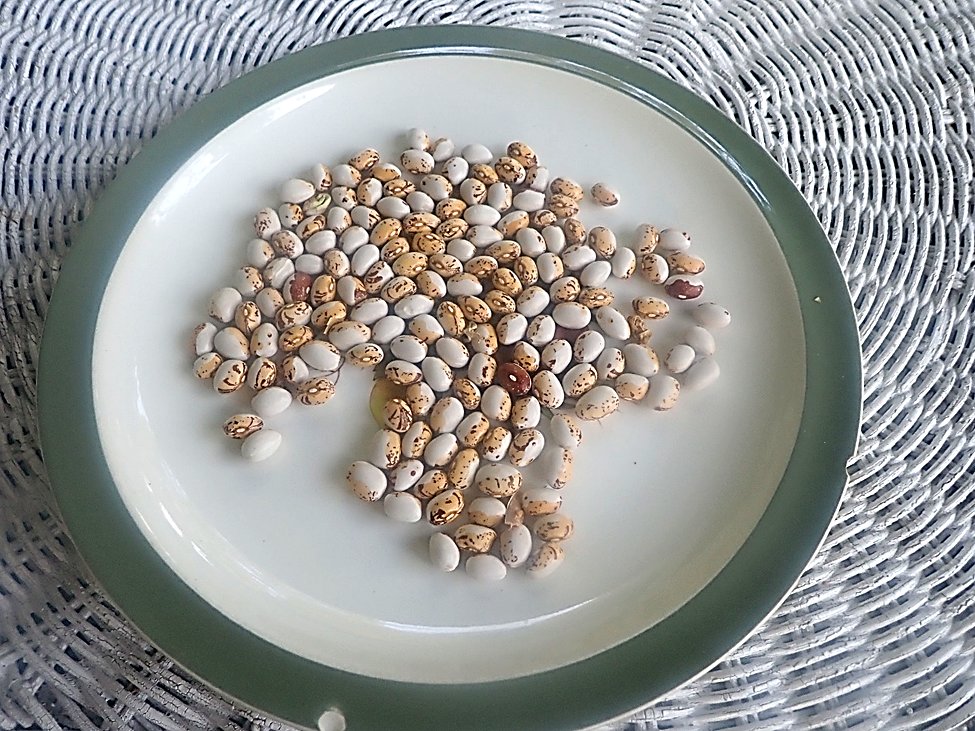
The colour pattern of the seed is striking, among the most beautiful I have seen. The pattern combines patchy colour as in a typical yellow-eye variety seed, with stripes and speckles as in cranberry beans. The white base colour is artfully splashed by a large buff to yellow orange patch centred on the scar. The edges of the patch meander sinuously over the upper part of the seed. Maroon speckles and stripes mark the coloured patch sometimes escaping onto the white body of the bean. To the Japanese the marks resembles those on a tiger, hence the name Tora-mame or Tiger Bean.
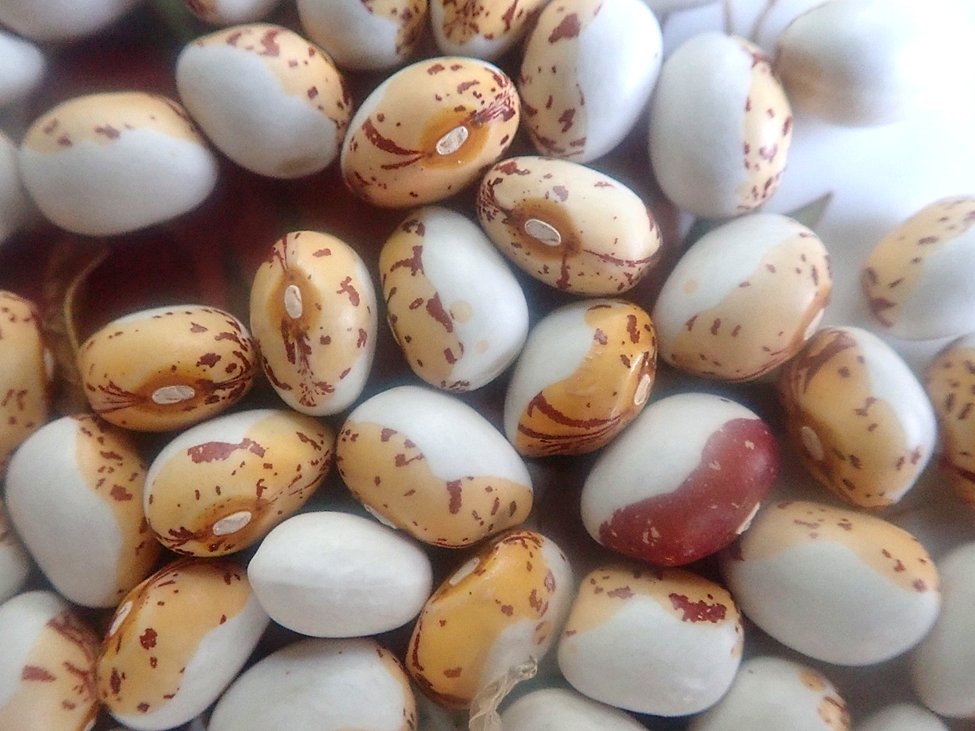
Seeds of Tora-mame common bean (Phaseolus vulgaris) with their artful decoration. Though generally with an oval outline, several show the flattened and angled end developed in a tightly filled pod. Photo Richard Hebda.
Tora-mame beans develop and mature over a season of moderate length. One year I sowed seeds on April 30 under plastic sheeting preceded by overnight soaking. The first seeds emerged May 6 and half were up by May 13. Not all the seeds germinated a pattern I have noticed over several years. Vines 1 m (40”) tall had grown up fencing support by June 1, rapidly reaching 2 m (79”) on June 26. There were lots of flowers at this time too. On July 8 flowers occurred widely especially toward the top and 5-8 cm (2-3″) pods had developed. Full green pods covered the plants by July 22 and flowering ceased. Plants and pods rapidly matured after this time, plants yellowing by July 31 and pods full and yellow. I harvested all pods, mostly dry by August 11, 102 days from sowing. Many pods were ripe before this indicating a short seed-to-harvest interval for a pole bean. Even in the cool damp year of 2024, 80% of the pods ripened within 102 days with the last of them ready within 116 days.
Yields have always been good over the years that I have grown this variety. Even if all the seeds do not germinate the plants branch widely and those from seeds resown 2-3 weeks later catch up quickly.
I obtained 0.43 kg/m (0.29 lbs/ft) in a short well-filled row one year and 0.38 kg/m (0.26 lbs/ft ) in a longer row with only five plants a second year. These are solid yields for a pole bean that ripens in a short season.
In Japan Tora-mame beans are said to be among the best tasting ones. Their green pods can be eaten as snap beans or the dry beans can be cooked. One unusual method involves simmering the dry beans and sweetening them. According to the Japanese website https://seizaemon.com/en/products/beans/ , Tora-mame beans are one variety suited to this style of cooking. Simmering maintains bean texture and form including its surface finish. Simmered beans are then sweetened and eaten on their own or used as a topping for ice cream and yoghurt.
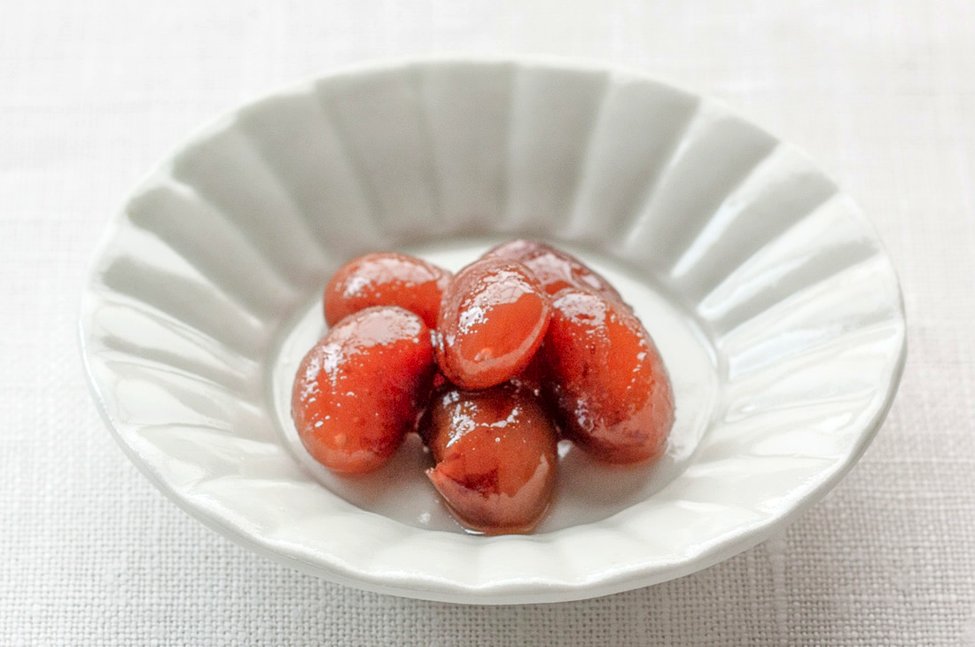
Tora-mame beans simmered and sweetened for a Japanese dessert. Source https://seizaemon.com/en/products/beans/
We can grow Tora-mame a beautiful Japanese pole bean in many parts of southern Canada. Its attractively decorated seeds make a delicate tasty dessert. If you can find Japanese seed, or perhaps a similar heritage variety in North America, you too can enjoy this Asian delicacy.