
Richard Hebda
Deep in the mists of time a beautiful bean arose probably in Europe from South American roots. Sometimes white and artistically speckled, sometimes a rich dark red, the Cranberry bush bean is among the most attractive of dry beans. Recorded in the 1930’s by U.L Hedrick in Beans of New York, Vegetables of New York Volume 1 Part 2 (Education Dept. State of New York) Cranberry bush types were known well back into the 1800’s. Cranberry bush is a secondary name given to the variety. Red-speckled beans of this kind have been widely known as Dwarf Horticultural beans with names such as Boston Favourite and Goddard. There were numerous varieties described in Hedrick’s book. They appear to be similar in appearance to “Borlotti” type beans as recently described on our site at https://heritagepotato.ca/heritage-beans/doukhobor-discovery-koozen-drying-bean-2-an-early-bush-bean-from-southeast-british-columbia/.
I received seeds from a family member who picked them up at one of Victoria’s (BC) Seedy Saturday’s. I got only 3 seeds which I planted and from which I obviously got more. Three years after receiving them I was able to plant a short and dense row. Squeezed by other bean varieties on one side and potatoes on the other, those beautiful beans now provide me with reliable yields easily accommodated within our west coast growing season.
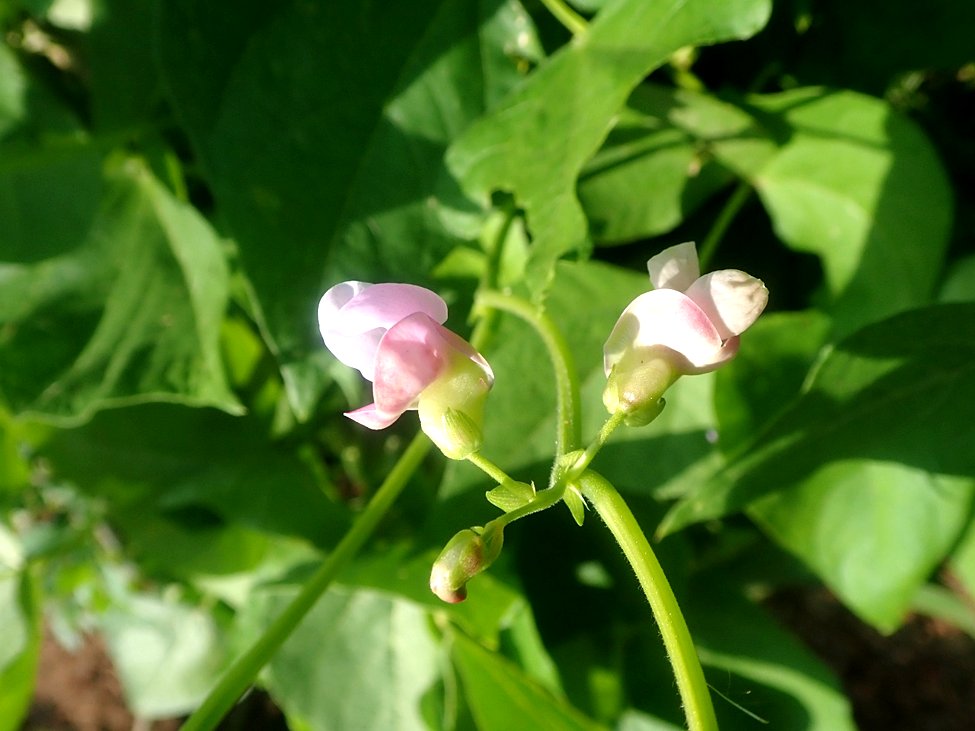
Sublimely beautiful pink flowers of common bean (Phaseolus vulgaris) “Cranberry Bush” variety. Brentwood Bay, July 13, 2023. Photo Richard Hebda
Cranberry Bush beans grow into robust bushy plants mostly without trailing stems, but with a tendency to vine. They are determinate meaning that they grow to mature size and then yellow and die. My plants have grown from 45 to 65 cm (18-25”) tall on average about 55 cm (20”). The flowers are a delightful pale to medium pink, generally placed at the top of or even above the leaves.
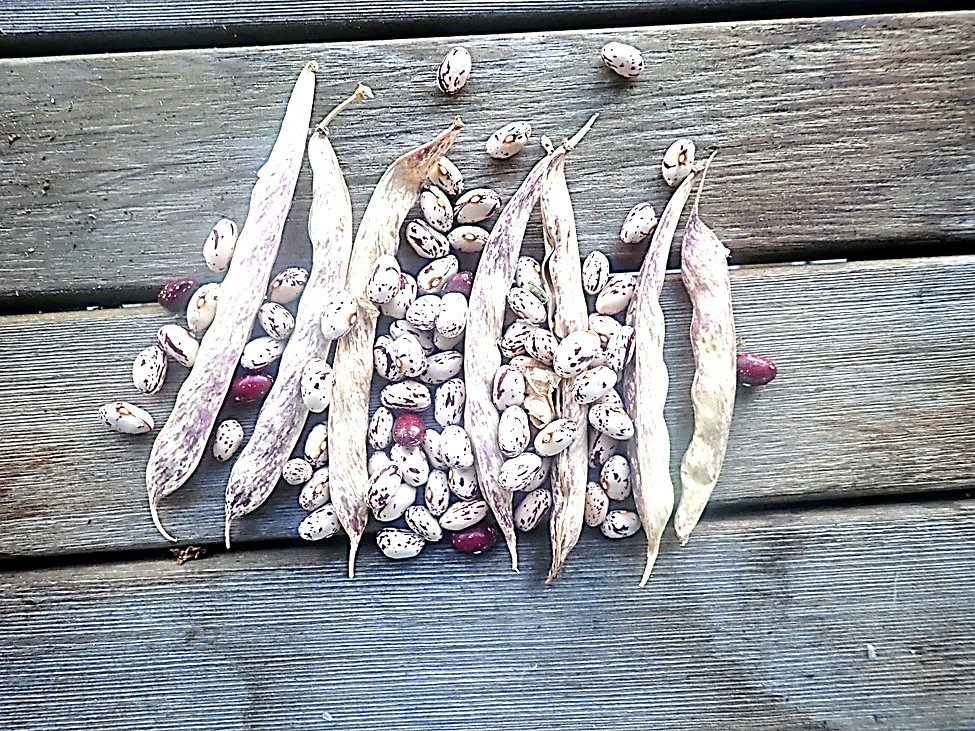
Blooms mature into robust pods with a curved point. Pods widen slightly toward the tip especially around the last seed. Immature pods are often striped or almost entirely bright cranberry red. Dry pods are yellowish striped by maroon markings. The edge or suture of the dry pod has a prominent ridge. Pod length ranges from 13-16 cm (average 14.5) (5-6”). Pods are round to slightly flattened in cross section and about 1.5 cm (3/5”) wide and 1.3 cm (1/2”) thick. The point is straight to slightly curved with a length of 1.3-1.6 cm. (1/2”). Interestingly the pods fill and colour quickly but take some time to dry.
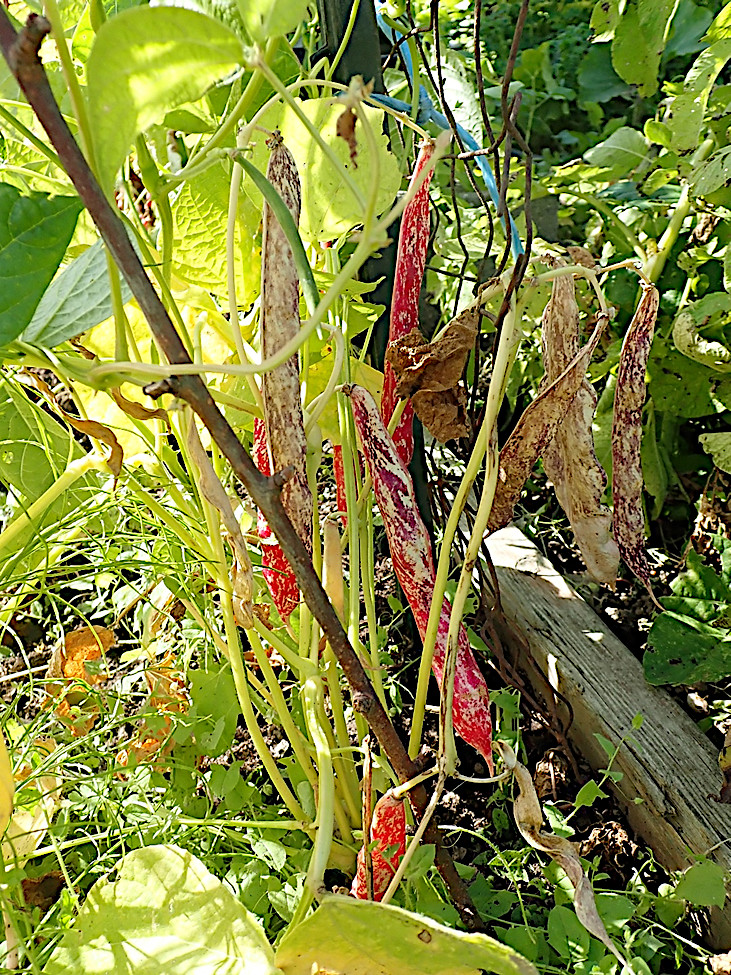
Maturing seed pods of Cranberry Bush bean, August 27, 2020 Saanich Peninsula, Photo Richard Hebda.
There are 4 to 6 seeds per pod. Seeds have and oval to rectangular outline with one or both ends flattened against the neighbouring seed. Length ranges from 1.1 – 1.4 cm (about ½ “) and the circular cross section is 0.8- 1.0 (1/4”) cm across. The attachment scar is surrounded by a wide brown ring.
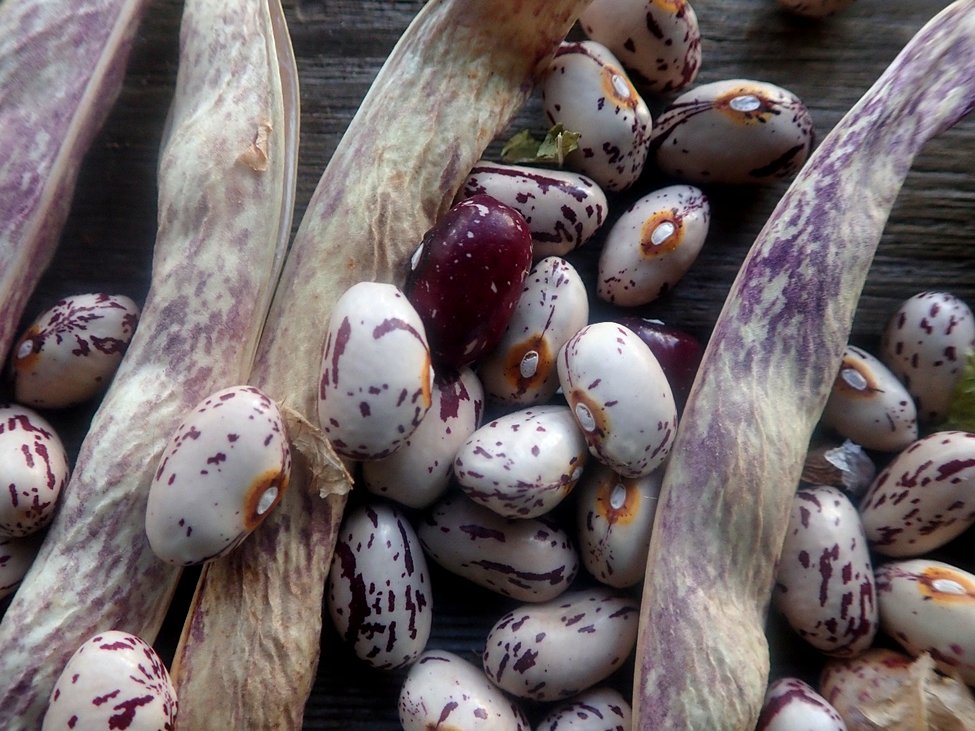
Maturing seed pods of Cranberry Bush bean, August 27, 2020 Saanich Peninsula, Photo Richard Hebda.
In 2023, a relatively normal growing season on the Saanich Peninsula, beans sowed May 6 were mostly up by May 20 and some had even germinated by May 15. The first flowers appeared June 27, and bushes were covered in pinkish blooms on July 3. Just about two weeks later, on July 19 there were many full green seed pods. Within a week many pods had turned red, and the plants had begun to yellow. By August 2 pods were mostly pink and with yellow blotches. Harvest took place August 18 when most pods had dried resulting in a seed-to-harvest interval of 104 days, reasonable for many parts of Canada. However, in the cool damp year of 2024 the growing time to harvest was 128 days needing 3-4 days air drying on a fence. In 1931, Hedrick noted that different forms of bush cranberry had varied ripening times, some ripening late by New York State standards. On this basis Cranberry ripening may vary widely with growing season conditions. It might be worth trying seed from different sources.
Yields have varied widely over the years from 0.21 kg/m (0.14 lbs/ft) to an exceptional 0.38 kg/m (0.26 lbs/ft) for a bush bean. However, once they turn from bright pink to having purple markings the seeds are ripe and the pods begin shattering. When I hung bushes to dry on a fence, I had to harvest them over a large paper bag to catch seeds. Remarkably 50 % of the leaves were still green at this time.
Back in the early 1930’s Hedrick noted the value of Cranberry (Horticultural Shell) beans as a shelled bean and for dry seeds. According to him the texture was “floury” (farinaceous) and the flavour tasty. As he put it these types of beans were “worthy of more extended use”. Clearly his challenge has been taken up since then. Today Cranberry beans have many diverse uses. One dish combines the beans with pasta to make a thick soup. They can be mixed into a bean salad or baked. Rice mixes well with the cooked beans in soup or a thick rice and beans dish. A most interesting dish combines polenta and bean which is then cut into blocks and fried (https://www.allrecipes.com/gallery/cranberry-bean-recipes/).
Cranberry bush beans ripen in a timely manner and can produce solid yields. Known for two centuries their value has now been recognized in many different delicious dishes. You too can grow and enjoy them in many parts of Canada.