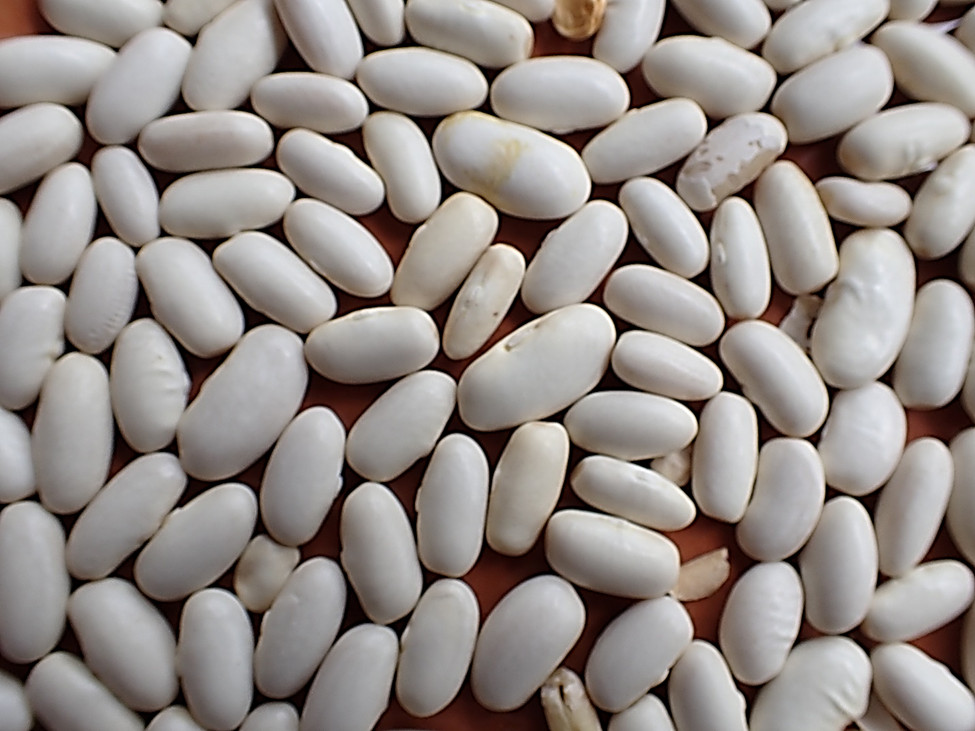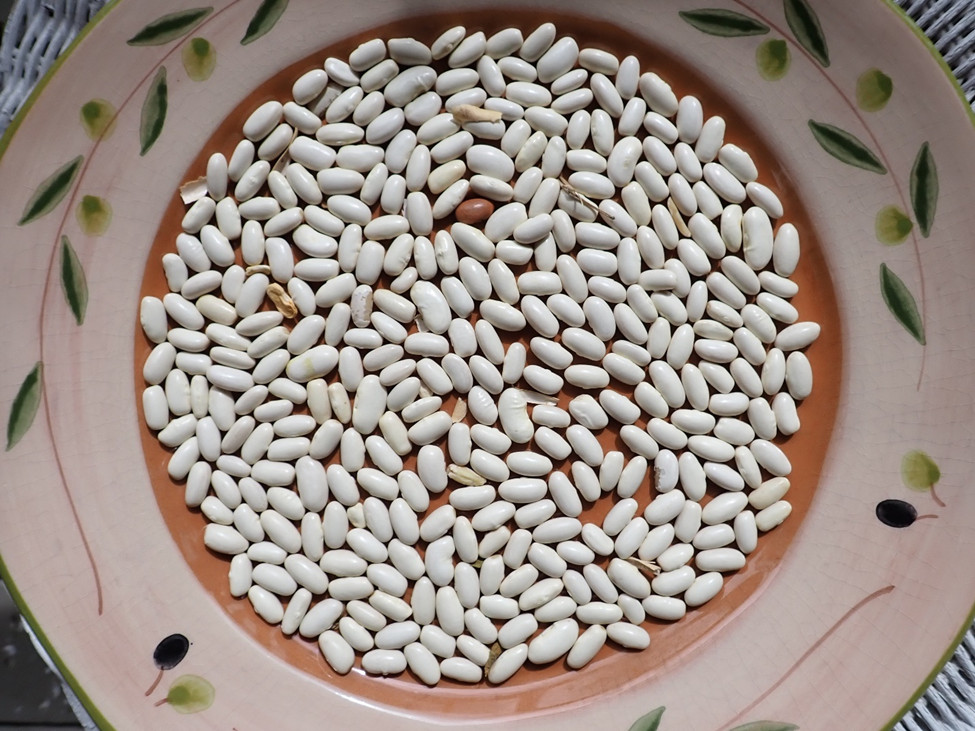
The Mediterranean diet is highly touted as a way to live healthy and long. Beans are part of that diet and among them the white Cannellini bean is best known. You can buy Cannellini beans in the store in a can or dried. However, where the growing season permits, you can also grow it in your garden and get abundant yields of this widely adaptable protein supply.
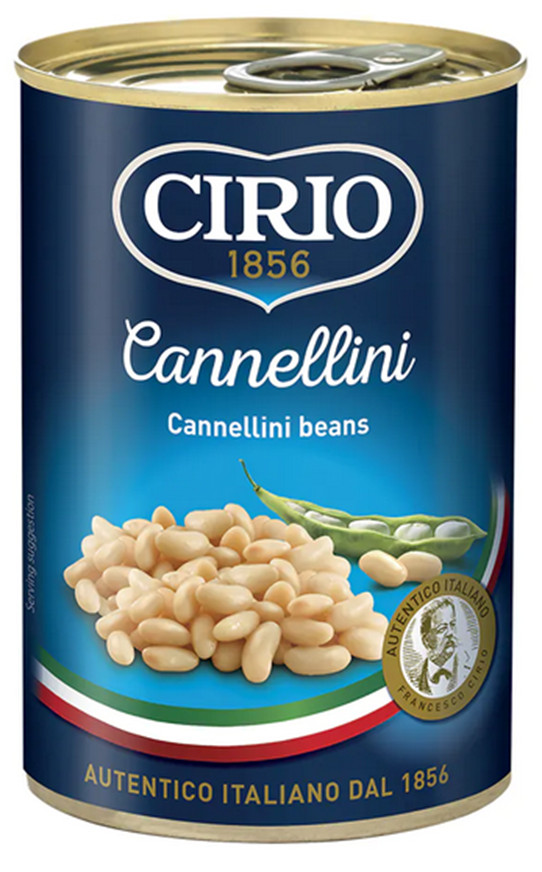
Authentic Italian Cannellini, possibly grown and preserved since 1856. Source https://www.cirio1856.com/products/cannellini-beans/.
Many sources describe this variety as a type of Navy bean. White Navy beans apparently originated in the US and have been widely used to feed American sailors since the 1800s. However, Cannellini beans have a long European history, and several accounts link their origin to Italian immigrants from Argentina in the 1800s. To them the white seeds resembled a cinnamon-flavoured candy. “Cannella” in Italian means cinnamon and thus the name Cannellini. People brought the seeds back to Italy where they are now established as a staple in Italian Cuisine. To learn more about the history of Cannellini beans visit the https://www.thedailymeal.com/1622900/how-cannellini-beans-got-name/.
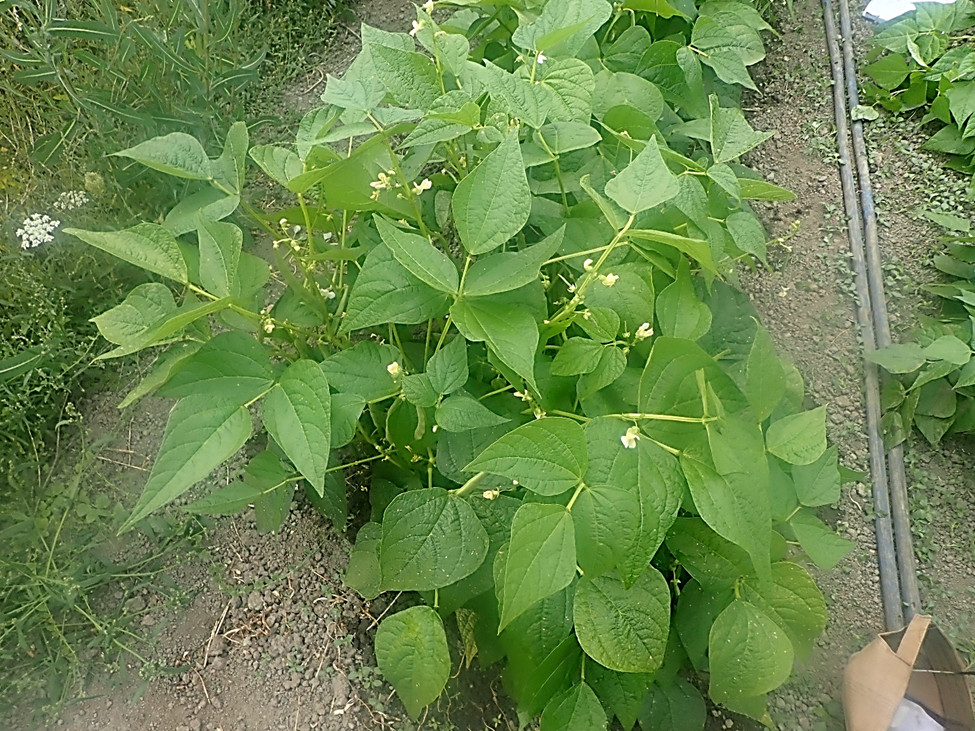
Cannellini common bean (Phaseolus vulgaris) plants in full bloom August 16, 2024, Saanich Peninsula, BC Photo Richard Hebda.
Plants grow as robust bushes with wide-spreading stems but not as tall as pole beans. Typically, they stand 40-60 cm (16-24”) (average 50 cm =20”) tall rarely spreading to 90 cm (36”) wide if grown without a fence. At its base the strong stem is 2-3 cm (1”) thick and produces many branches near the base. Flowers are white and the resulting pods are distributed widely from top to bottom of the branches.
Straight to slightly curved pods turn pale beige to pale yellow when dry. Though firm to hard, they fortunately split easily along back. The pods are more or less round in cross section, and the seeds stand out when mature with the space in between pinched. Length varies from 11-13 cm (5”) and diameter about 0.8 cm (1/3”). The pointed tip is straight to slightly curved and about 1 cm (2/5”) long. Four to five seeds usually occupy the pod, often with one aborted seed.
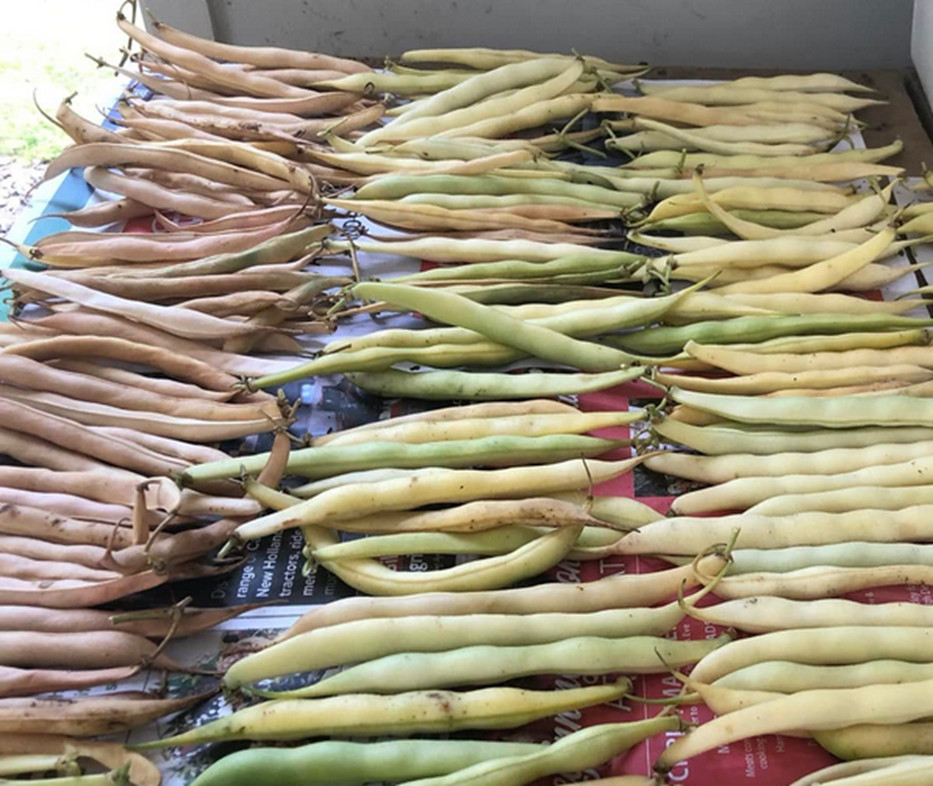
Cannellini common bean (Phaseolus vulgaris) pods drying in Piopio, New Zealand. Photo posted February 6,2025 on Facebook by Karen Anne Barrett.
Seeds are shiny white and elongate, somewhat barrel-shaped and rounded in cross section. A visible thin white line or ridge extends from the scar sometimes all the way around the seed. The scar is small, narrow and may rise slightly above the seed’s surface. Length ranges from 1.3-1.6 cm (2/3”), and height (about 0.8 cm =1/3”) is slightly greater than thickness (0.6 cm).
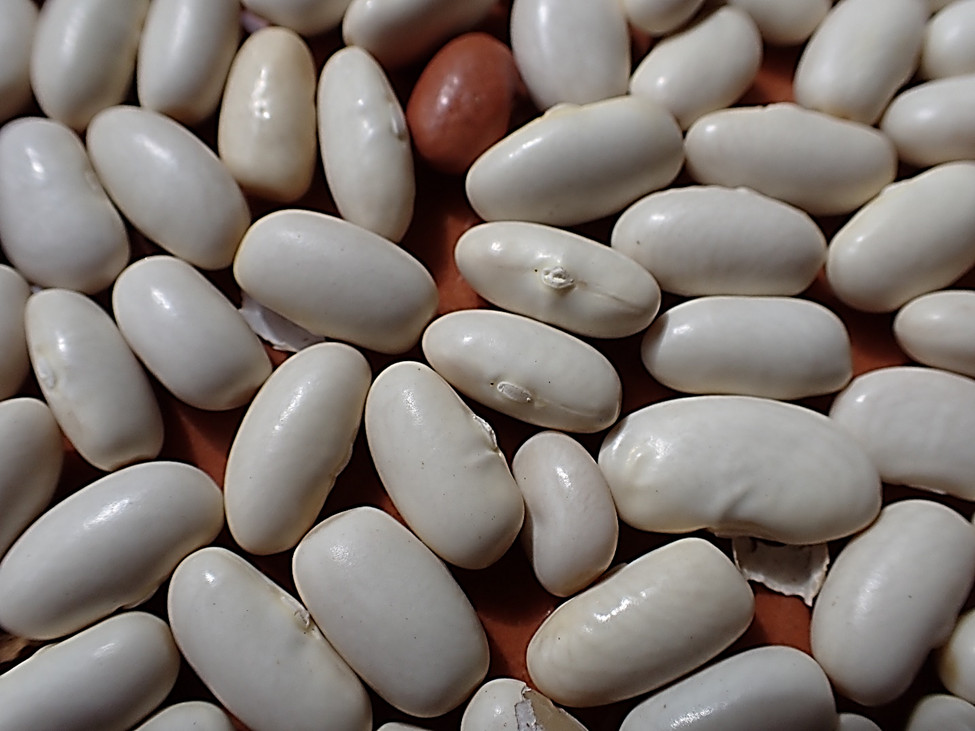
Pearly white seeds of Cannellini common bean (Phaseolus vulgaris) showing raised scar zone and line or slight ridge extending around the seed. Photo Richard Hebda.
My first attempt at growing Cannellini beans came from seeds bought in bulk at a nearby Italian grocery store, I have often found that dried food beans are perfectly suitable for growing in the garden. I soaked them for about 18hrs as I often do with food-grade dry bean seed, then sowed them on May 20th. By June 20 all plants had emerged and were in their second leaf stage. Buds showed by July 3 and white flowers covered the plants by July 19. At this time there were even a few 2-5 cm (1-2”) mini pods near the base. Full bloom extended from July 25 to August 2 by which time there were many full green pods. August 10 saw many pods and continued flowering, however no pods were mature or dry. I harvested September 14 at which time plants had begun to yellow but remained dominantly green. Scattered flowers and green pods persisted. The sowing-to-harvest time was 116 days. In a later much cooler year (2024) the time to harvest was 142 days with the harvest in mid October for the same sowing date. My version of this variety seems highly sensitive to cool and damp growing seasons. Scanning the internet there seems to be a wide range of seed-to-harvest times, as little as 75 days, likely because the name Cannellini applies to several white bean types from Italy. You might want to try several seed sources and discover the strain that works best for your growing conditions.
For the two years of record, yields varied widely. In one year, Cannellini beans were grown alternating with potatoes and the adjusted yield was 0.17 kg/m (0.12 ft/lb). Grown on their own with low fence support yield was 0.38 kg/m (0.26 ft/lb) and excellent result for a bush bean. Obviously a row of Cannellini on a short fence is the way to go for lots of white beans.
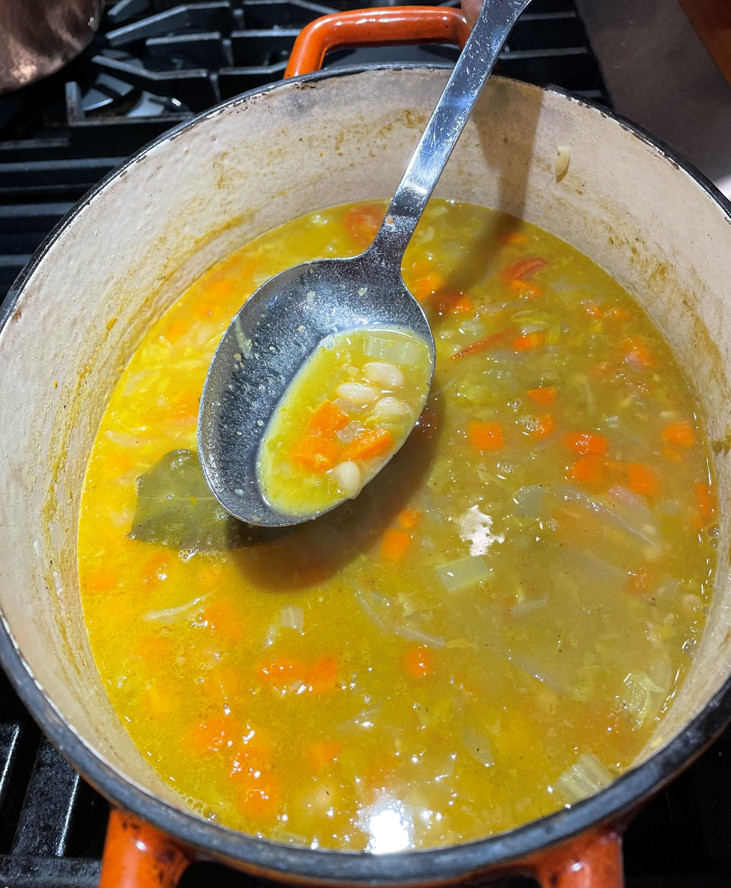
Mary Slanina’s bean soup made with organic canned Cannellini beans. Photo Mary Slanina.
Cannellini beans have a creamy texture, mild nutty flavour and keep their shape when cooked. Recipe choices are numerous for this exceptional bean especially because of the popularity of Italian cuisine. In the shelling state extracted from ripening pods they are suitable for simmering, sauteing, roasting and even frying. Dried beans need to be soaked, or prepared in an Instantpot. Cook without salt though, which toughens the skins. Use widely for soups and dips, Italian “pasta fagiole” seasoning according to your favourite traditions and tastes. We include two recipes from my Italian Canadian friend and cookery expert Mary Slanina from Victoria, BC with roots in the mountains of central Italy.
Join the Mediterranean food movement and add lots of Cannellini beans to your diet. They will grow and produce well provided you search for and choose a locally adapted variety and with a suitable growing season. Then try the huge range of different ways of cooking dishes developed for this popular Italian bean.